Why Your Website Is Not Ranking Even When SEO Looks Right
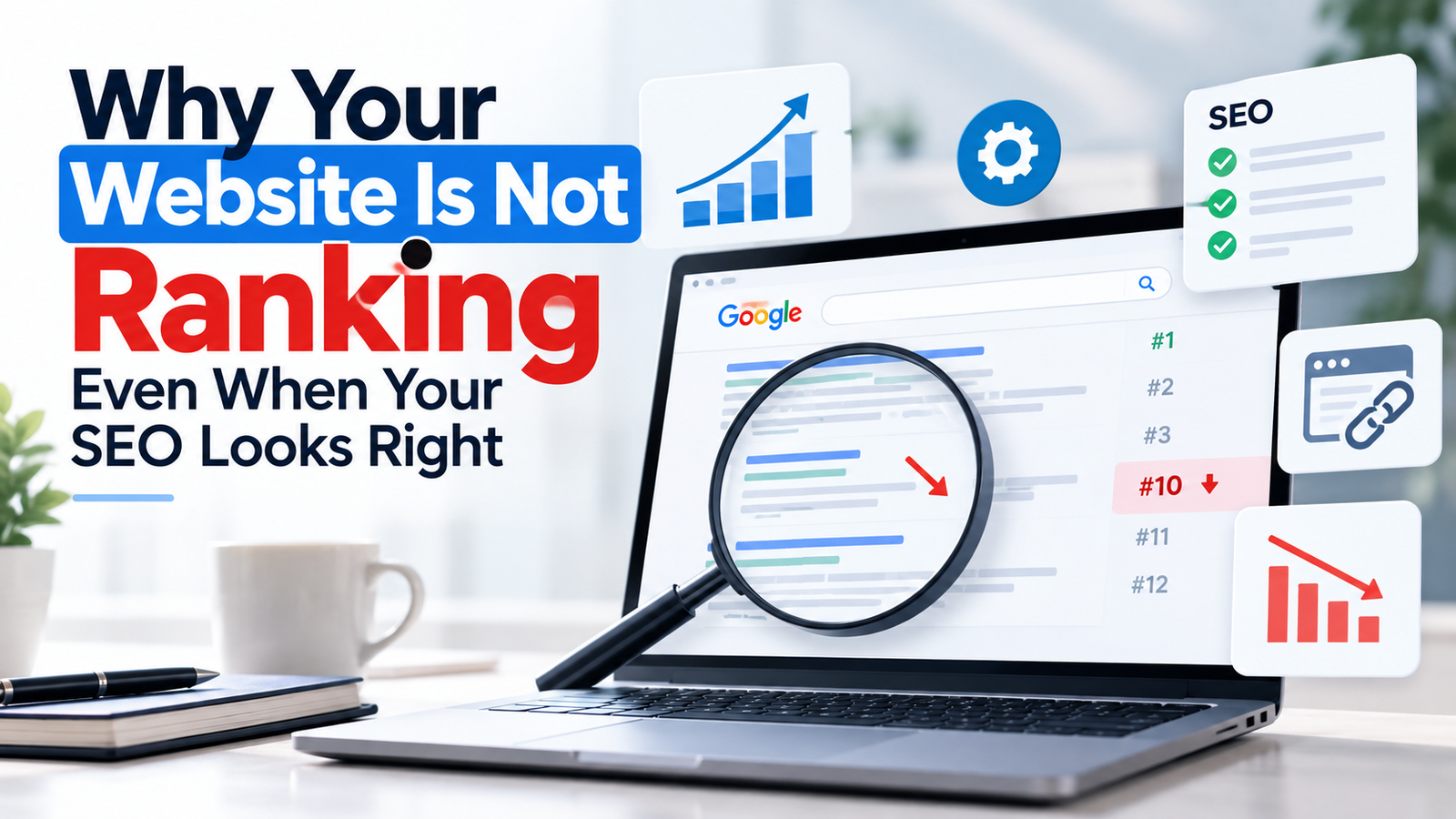
You have chosen relevant keywords, written useful content, optimized your titles, added internal links, and made sure your website looks professional. On the surface, your SEO appears to be in good shape. Yet your important pages are still sitting far below the results you expected, or they barely receive organic traffic at all. This is one of the most frustrating situations for website owners because there is no obvious problem to fix.
The reality is that a website can look well optimized without giving search engines enough reasons to rank it prominently. Search visibility is influenced by how easily pages can be discovered, whether they can be indexed, how well they satisfy search intent, the overall usefulness of their content, website structure, external signals, technical performance, and competition. Instead of making random SEO changes, the better approach is to identify where the ranking process is actually breaking down.
Good-Looking SEO and Effective SEO Are Not Always the Same
Basic optimization is important, but completing an SEO checklist does not automatically make a page competitive. A title containing the target keyword, a meta description, several headings, image alt text, and a green score inside an SEO plugin can indicate that certain on-page elements are present. It does not prove that the page deserves a prominent position for a competitive search.
Search engines need to understand what a page is about, but they also need to determine whether it provides a useful result for the person searching. This is where websites often struggle. Their pages may be technically optimized around a phrase while offering roughly the same information as dozens of competing pages. If your page does not satisfy the query particularly well, simply repeating the keyword or changing the meta description is unlikely to solve the underlying problem.
Start by Separating Indexing Problems From Ranking Problems
Before rewriting your content, determine whether the page is actually available to appear in search results. Indexing and ranking are related, but they are not the same thing. A page cannot compete meaningfully in organic search if a search engine cannot crawl it properly or has not indexed it.
Google Search Console is particularly useful at this stage. Inspect the exact URL and review its indexing information. A page may be blocked by a noindex directive, affected by a canonical pointing somewhere else, difficult to discover because of poor internal linking, or excluded for another reason. Sitemap and crawling issues can also make discovery less efficient.
If the page is indexed but appears in weak positions, the problem has moved beyond basic indexability. You can then investigate relevance, content quality, authority, internal structure, competition, and user experience instead of repeatedly requesting indexing for a page that Google already knows about.
Your Page May Be Targeting the Keyword but Missing the Search Intent
One of the biggest differences between visible optimization and effective optimization is search intent. Keywords tell you what people type. Intent helps explain what they expect to find after typing it. Two pages can target exactly the same phrase while only one provides the type of result the searcher actually wants.
For example, someone searching for a beginner’s guide usually needs explanation and practical steps. A person searching for a service may instead want to understand the offer, process, credibility, pricing considerations, and how to take the next step. A product-oriented query may require comparisons or purchase information. If you publish a commercial service page for a query where search results are overwhelmingly educational guides, your keyword usage can be excellent while your page format remains poorly aligned with the query.
Check the Results Before Deciding What the Page Needs
Search for the main topic and study the types of pages already appearing. Look beyond exact wording. Are the results guides, service pages, category pages, tools, product pages, comparisons, or definitions? What questions do they answer? How deeply do they cover the subject? This does not mean copying competitors. It helps you understand the problem search engines appear to be solving for that query and where your page needs to offer something genuinely useful.
Your Content May Be Optimized but Still Too Shallow
A page can contain the right keywords without covering its subject adequately. This often happens when content is created around a target word count rather than around the user’s questions. Adding more paragraphs is not automatically the solution either. A long article filled with repetition can be less useful than a shorter page that explains the topic clearly and completely.
Consider whether the page answers the questions a real visitor would naturally ask next. Does it explain important concepts? Does it provide examples where they help? Does it address limitations, alternatives, common mistakes, or practical next steps? Is the information organized so readers can quickly find what they need? Useful depth comes from improving the answer, not simply increasing the number of words.
A page does not become valuable because it is long. It becomes valuable when the reader has less uncertainty after reading it.
Your Website May Not Be Sending Clear Internal Signals
Internal linking is easy to underestimate because it looks simple. In practice, it helps both visitors and search engines understand relationships between pages. If an important page is buried several clicks deep, receives almost no contextual internal links, or is disconnected from closely related content, it may be harder for search engines to understand its place within the wider website.
Imagine a site that publishes ten strong articles about SEO but never meaningfully connects them to its main SEO service or related guides. Each article exists, but the site structure does little to communicate which pages are central and how the topics relate. A more deliberate structure can connect supporting articles to broader hub pages and connect related resources where the link genuinely helps the reader.
- Link from relevant articles to important service or topic pages
- Use descriptive anchor text rather than vague phrases everywhere
- Make important pages reachable through a logical site structure
- Connect closely related articles where readers may need additional context
- Review older content when publishing a new page and add useful links where appropriate
Your Site May Lack Enough External Authority for the Competition
Some ranking problems are not caused by the page itself. You may have produced a strong resource, but the websites already competing for the query may have far stronger reputations, more relevant mentions, better-known brands, or more established backlink profiles. This becomes particularly noticeable in competitive industries.
Backlinks should not be treated as a numbers game. A large collection of irrelevant or low-quality links does not automatically create meaningful authority. Relevant editorial mentions and links from credible websites can be more useful signals than accumulating links simply to increase a third-party metric. Guest posting can be part of this strategy when it is approached as genuine publishing on relevant websites rather than mass placement without regard for quality or context.
It is also important to remember that metrics such as DA and DR come from third-party SEO platforms rather than Google itself. They can be useful for comparative research, but they should not become the sole basis for deciding whether a website or backlink is valuable.
Technical SEO Problems Can Hide Behind a Good Design
A visually polished website is not necessarily a technically healthy website. Search engines interact with the underlying site, not just the design visitors see. A beautiful page can still suffer from unnecessary redirects, duplicate versions, incorrect canonical tags, broken internal links, weak mobile behavior, crawling restrictions, or slow resource-heavy layouts.
Technical issues are particularly important when they affect many pages at once. For example, an incorrect template-level canonical can create confusion across an entire section of a site. Similarly, an accidental noindex setting can prevent valuable pages from being eligible for normal search visibility regardless of how well their content has been written.
| Area to Check | Possible Problem | What to Review |
|---|---|---|
| Indexing | Page is excluded from search | Search Console, robots directives and noindex settings |
| Canonicalization | Another URL is treated as preferred | Canonical tags and duplicate page versions |
| Internal Links | Important page is poorly connected | Site navigation and contextual links |
| Mobile Experience | Layout is difficult to use | Responsive behavior, spacing and readability |
| Performance | Heavy page creates a poor experience | Images, scripts, fonts and Core Web Vitals |
Your Pages May Be Competing With Each Other
Sometimes a website creates several pages targeting nearly identical search intent. For example, separate articles may be written for “SEO content writing,” “content writing for SEO,” and “SEO-friendly content writing” even though each page answers essentially the same question. Instead of building three distinct resources, the site may create unnecessary overlap.
Review which URLs receive impressions for your important queries in Search Console. If several pages continually appear for the same topic without a clear reason for each to exist, reconsider their roles. In some cases, improving one comprehensive page and consolidating overlapping material can create a clearer structure. In others, the pages can remain separate if each genuinely serves a different intent.
Your Website Experience Still Matters
SEO should not be separated from the experience of using the website. Visitors should be able to understand the page, read it comfortably, navigate to related information, and use it effectively across devices. Intrusive elements, confusing navigation, unreadable mobile layouts, excessive visual clutter, or slow interactions can weaken an otherwise strong page.
Google’s Core Web Vitals focus on aspects of loading performance, responsiveness, and visual stability, but technical scores should not become another isolated checklist. The wider objective is straightforward: create a page that loads reliably and is comfortable to use. Improving performance is valuable when it improves the actual experience rather than simply chasing a perfect testing score.
Your SEO Changes May Need Time and Better Measurement
Another common mistake is deciding too quickly that an SEO change failed. Search engines need time to crawl updated pages, process changes, and reassess them within a competitive environment. The appropriate time frame varies, and there is no universal number of days after which every optimization should produce a ranking improvement.
Instead of checking only whether a keyword moved from one position to another, monitor a broader set of signals. Are impressions increasing? Is the page appearing for more relevant queries? Is click-through improving? Are previously unindexed pages becoming indexed? Is organic traffic reaching useful pages? These signals can reveal progress or problems more clearly than obsessing over a single keyword position.
A Better Way to Diagnose a Page That Is Not Ranking
When a page underperforms, changing everything at once makes it difficult to learn what was actually wrong. A structured diagnosis is more useful. Start with accessibility and indexability, then move into relevance and competition. After that, examine the page’s depth, internal connections, external authority, technical experience, and actual Search Console data.
A practical order is: confirm the URL can be crawled and indexed; identify the dominant search intent; compare the page with the current competitive landscape; improve sections that fail to answer important questions; strengthen useful internal links; investigate technical issues; evaluate the site’s relevant authority; and then measure the effect of your changes over time. This turns SEO from random editing into a process of identifying and resolving specific weaknesses.
What to Do When Everything Really Does Look Right
If the page is indexed, technically sound, useful, aligned with intent, internally connected, and supported by reasonable authority, the next step is not necessarily another rewrite. The competitive environment itself may be the limiting factor. Some queries are dominated by highly established websites, and newer sites may need to build topical depth and recognition gradually before they become strong competitors.
Continue improving the wider website rather than treating each URL as an isolated SEO project. Publish useful supporting resources, maintain existing pages, build legitimate industry visibility, strengthen internal connections, and improve the website experience. Sustainable search growth often comes from many connected improvements rather than one hidden setting that instantly moves a page to the top.
Final Thoughts
When your SEO looks right but your website is not ranking, avoid assuming that the solution is simply adding more keywords. Start by identifying whether you have an indexing problem, a relevance problem, a content problem, a structural problem, an authority gap, or a technical issue. The correct solution depends on the actual weakness.
Strong SEO is ultimately about making a website easy to discover, easy to understand, useful to the intended audience, technically reliable, and credible within its subject area. When content, internal structure, website quality, and relevant external signals work together, you create a stronger foundation for organic visibility than any checklist can provide on its own.
Frequently Asked Questions
Why is my website not ranking even though it is optimized?
Your website may be optimized at a basic on-page level but still face issues with indexing, search intent, content depth, competition, internal linking, technical SEO, or external authority. Check these areas separately instead of relying only on an SEO plugin score.
How can I check whether Google has indexed my page?
Use the URL Inspection tool in Google Search Console to review the specific URL. It can show whether the page is indexed and provide information that may help you investigate discovery, crawling, canonicalization, or indexing issues.
Can a website rank without backlinks?
Some pages can gain visibility without many backlinks, particularly for less competitive or highly specific searches. However, relevant external authority can become increasingly important when competing against well-established websites in competitive search results.
Does publishing more content improve SEO rankings?
Not automatically. Publishing content is useful when each page has a clear purpose and provides meaningful value. Producing many overlapping, shallow, or unnecessary pages can create a confusing site structure rather than improving organic performance.
How long does it take for SEO changes to improve rankings?
There is no fixed time frame. The impact depends on factors such as crawling, competition, website history, the significance of the changes, and the query itself. Monitor Search Console data and organic performance over time rather than expecting every optimization to produce an immediate ranking change.

admin
DeptScale is a digital growth agency helping businesses strengthen their online presence through guest posting, link building, content writing, web development, and practical digital solutions. We focus on quality, clarity, and sustainable strategies designed to support long-term digital growth.
Turn Insights Into Digital Growth
Explore DeptScale services for guest posting, content writing and web development to build stronger visibility, authority and sustainable growth.